
Last updated October 16, 2026
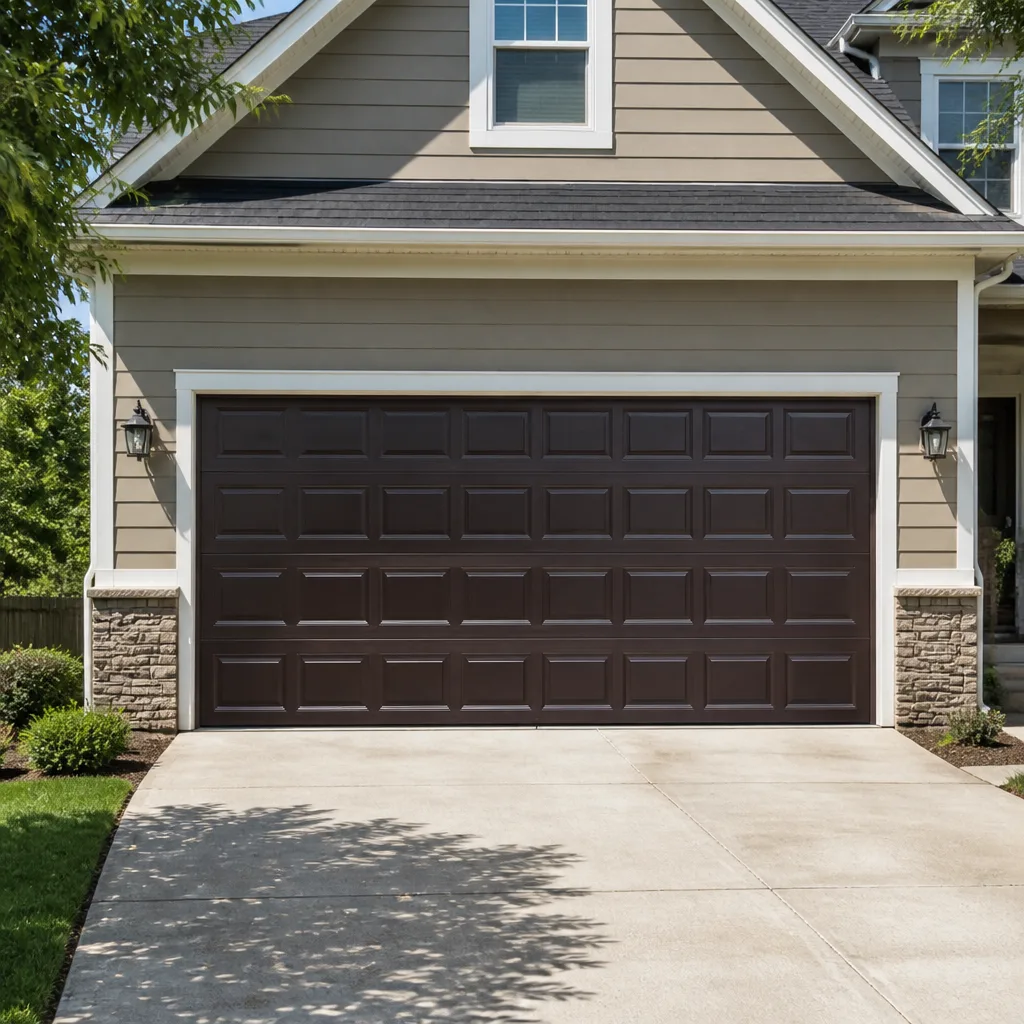 Raised-panel steel
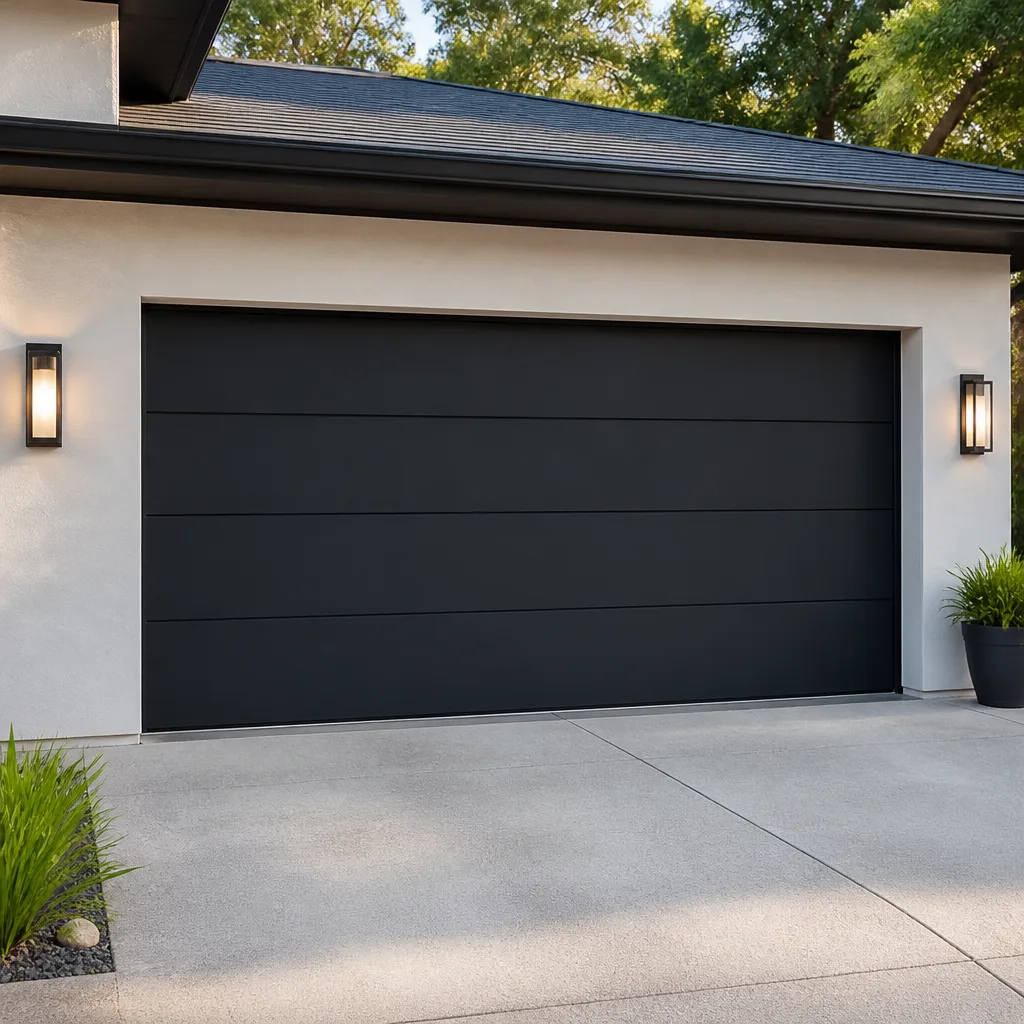 Modern flush
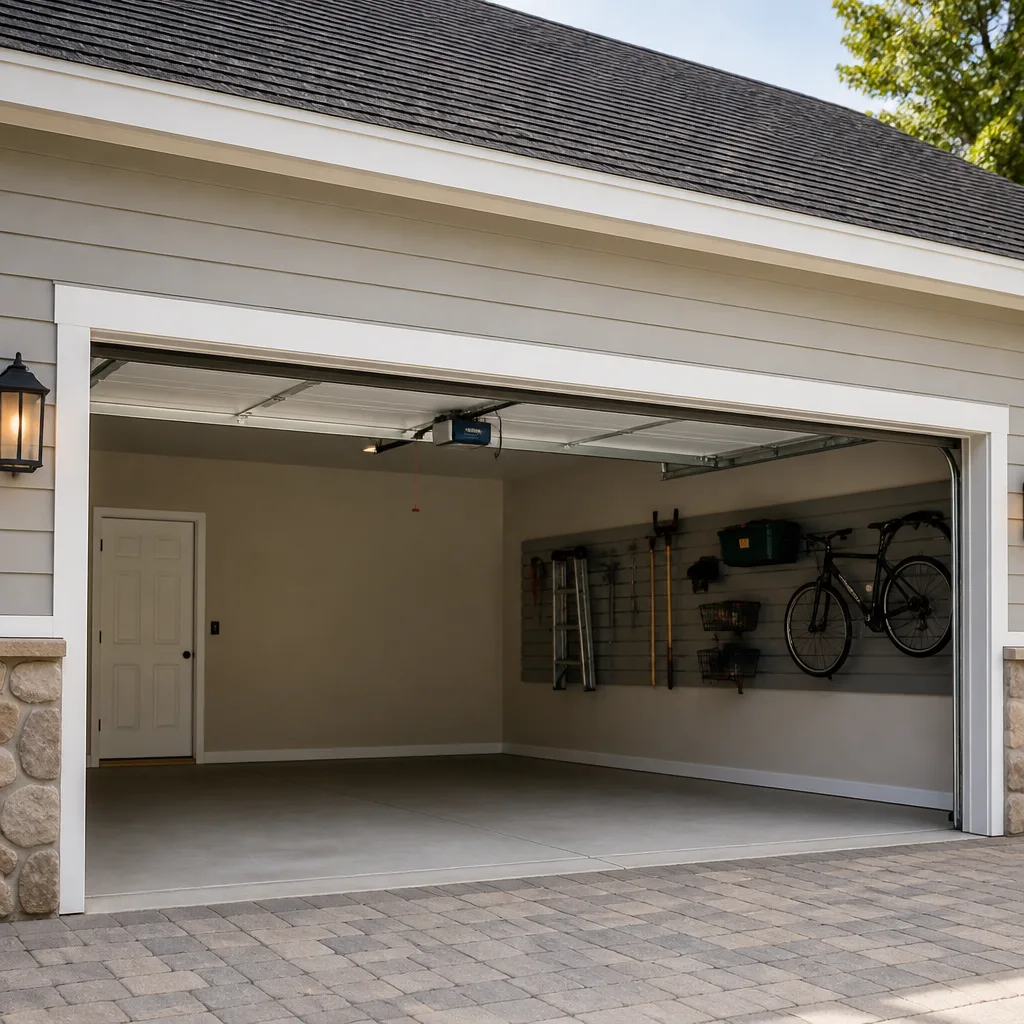 LiftMaster openers
Full 25-point door and opener safety check with every visit - springs, cables, rollers, tracks, and your LiftMaster or Chamberlain opener included
You get a price before we start. It does not change when the truck arrives.
Get your free estimateSeasonal Garage Door Care for Houston: Year-Round Homeowner’s Guide
Houston garage doors don’t fail in winter. They fail in September, after four months of heat cycling that fatigues torsion springs and warps bottom seals, and most homeowners find out when they go to close the door before a hurricane. This guide rebuilds the traditional seasonal care calendar around what Houston weather actually does to garage door components, because the standard spring/summer/fall/winter model hands you the right tasks at the wrong times. For a deeper dive, see The Complete Guide to Garage Door in Houston. You’ll learn what to check before the heat peaks, how to prepare for storm season, what a Houston “freeze” does to spring tension, and which parts humidity destroys first.
Quick Answer
Seasonal garage door care in Houston means timing maintenance around heat and hurricane season, not calendar seasons: check springs, seals, and rollers in March before peak temperatures arrive, inspect bracing and seals before June’s storm activity, and verify spring tension after any cold snap below 40°F. Most component failures in Houston are heat-driven or humidity-driven, so a schedule built around those two forces will catch problems months before a traditional spring/fall checklist would.
Styles & brands we work with
Table of Contents
- Why Houston Weather Breaks the Standard Seasonal Model
- Pre-Summer Checks (March – April): Catching Heat Failures Before They Happen
- Storm-Season Readiness (June – November): Wind, Rain, and Door Bracing
- Post-Storm Inspection: What to Check After a Tropical Weather Event
- The Short Houston “Winter”: Freeze Effects on Spring Tension
- Humidity and Your Hardware: Rollers, Hinges, and What to Swap
- Bottom Seals and Weatherstripping: Houston’s First Line of Defense
- Common Mistakes to Avoid
- When to Call a Professional
- Frequently Asked Questions
Why Houston Weather Breaks the Standard Seasonal Model
Most garage door maintenance guides were written for places with actual winters. They tell you to lubricate in the fall and check for ice damage in the spring. In Houston, that schedule misses the two forces that actually destroy garage door components here: sustained heat and Gulf humidity.
Let’s look at what Houston actually does to a garage door over the course of a year.
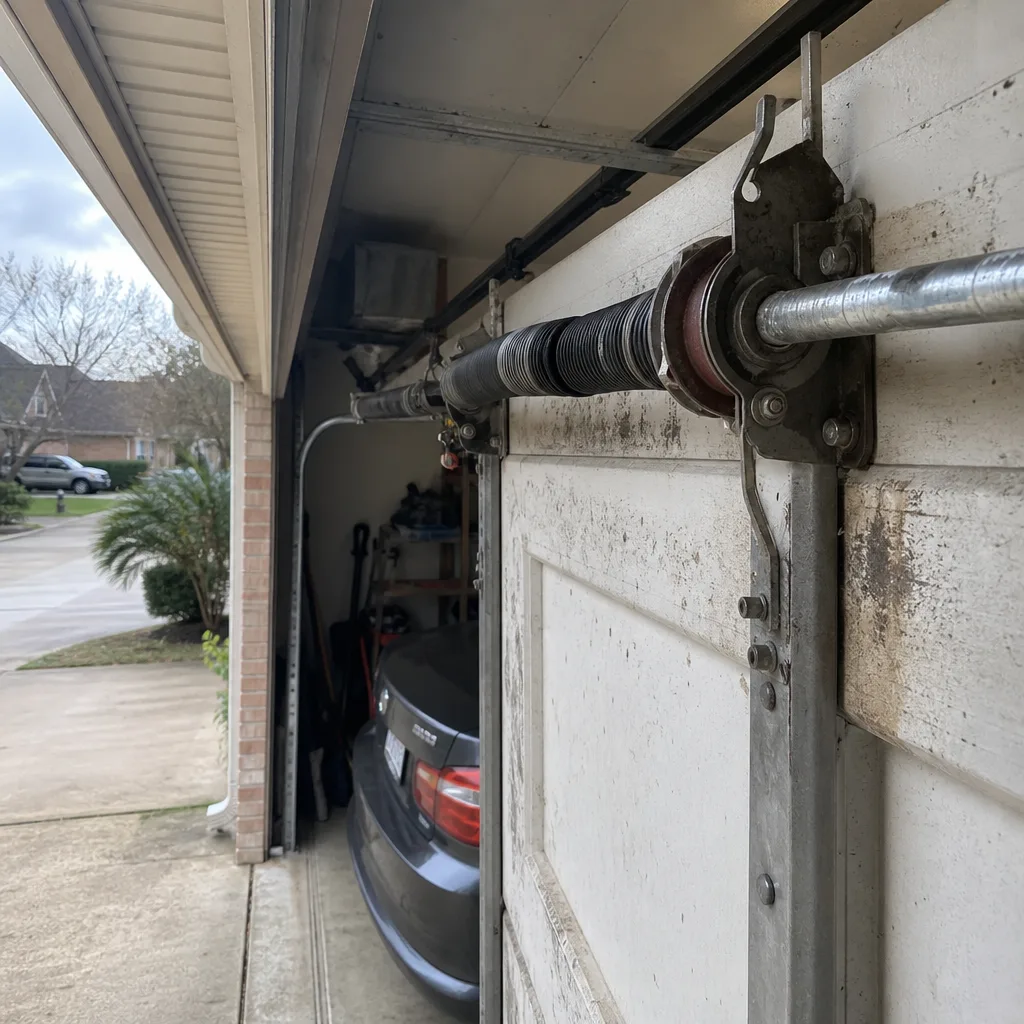
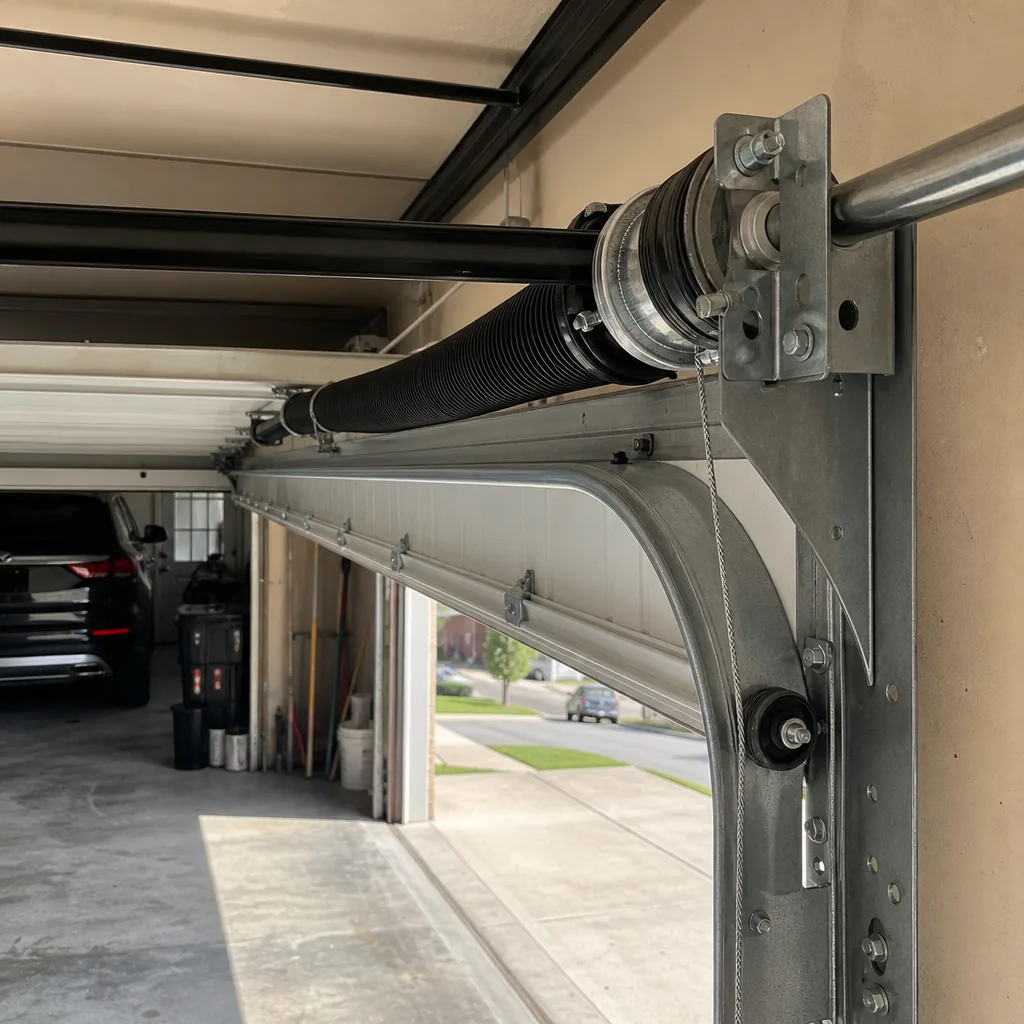
Heat stress on torsion springs. Torsion springs, the heavy coils mounted above the door that handle most of the lifting weight, are rated for a certain number of open/close cycles. Houston doesn’t shorten that cycle count directly, but it changes the operating environment. From May through September, the air inside an uninsulated Houston garage routinely reaches 100°F to 115°F. The metal in the springs expands and contracts every single day as temperatures swing from the 70s at night to triple digits in the afternoon. Over four months, that thermal cycling creates microscopic fatigue in the spring steel that a maintenance calendar built around freezing temperatures never accounts for.
We see the result every September and October: a spike in spring failures, right as homeowners are thinking about storm prep and the fall, not their garage door springs. The Garage Door Spring Repair in Houston call pattern in our own shop follows the heat, not the calendar.
Humidity’s slow corrosion work. Houston averages 75%+ relative humidity year-round, and coastal-adjacent neighborhoods like Clear Lake, League City, and Seabrook can sit higher. That moisture finds exposed steel in hinges, brackets, and roller stems. It doesn’t create dramatic failures. It creates a slow, quiet degradation that shows up as stiff rollers, squealing hinges, and eventually cracked hinge leaves.
Flood-driven seal failure. Houston’s flat topology and clay-heavy soil mean standing water is common after even a routine downpour. Bottom seals that sit in water, even for hours at a time, will rot and crack faster than seals in dry climates. A seal that would last five years in Dallas might last three in Houston, simply because it spends more of its life wet.
So here’s the rebuilt calendar for Houston homeowners:
- March – April: Pre-summer inspection and heat-prep (lubrication, seal check, spring cycle test)
- May – June: Storm-season readiness (bracing check, weatherstripping, opener battery backup test)
- June – November: Active storm vigilance (post-event inspections, quick response to any water or wind damage)
- December – February: The short cold window (spring tension check after freezes, seal inspection for freeze cracks)
Pre-Summer Checks (March – April): Catching Heat Failures Before They Happen
The most important maintenance Houston homeowners can do happens in March and April, not in September or October. The goal is to find heat-related wear before the peak stress period begins, because a spring that’s already fatigued in March is a spring that fails in September, right when you need the door to close before a storm.
Here’s the pre-summer checklist we recommend for every Houston home:
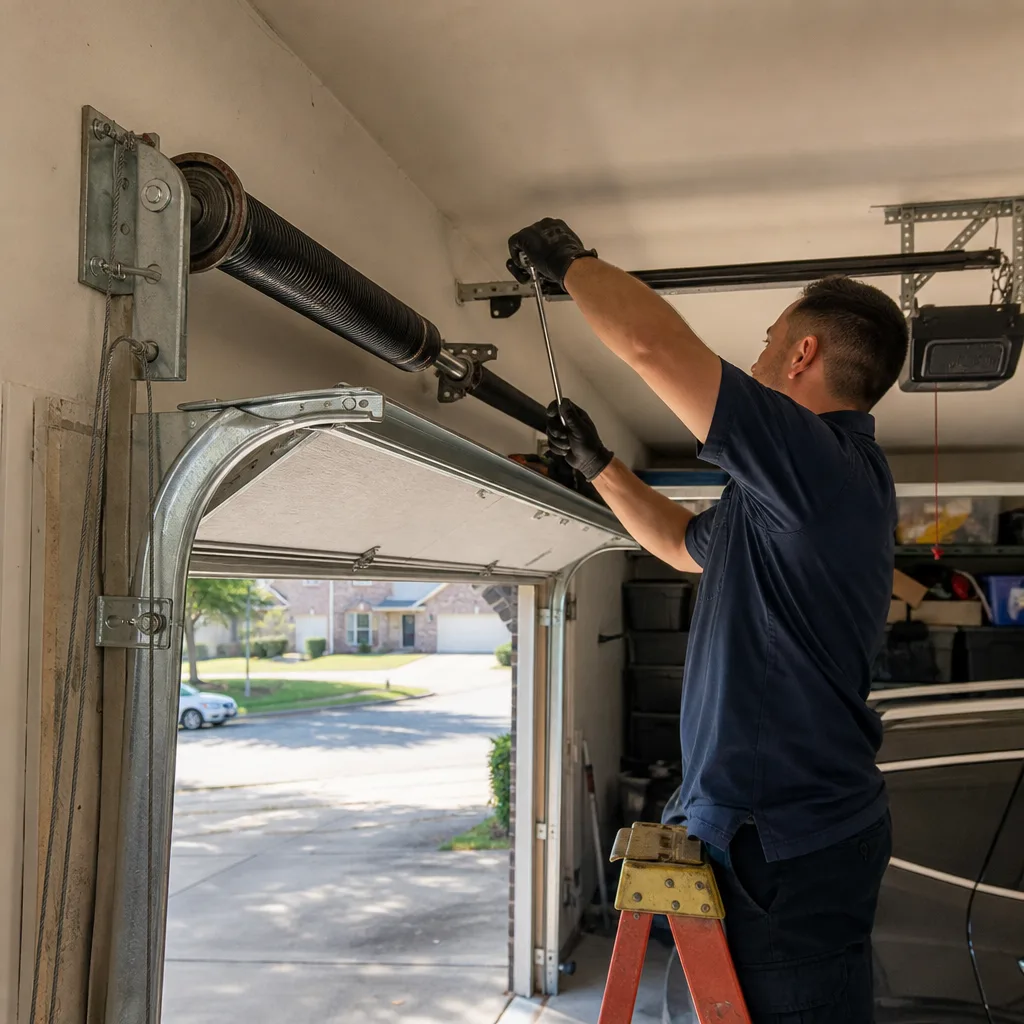
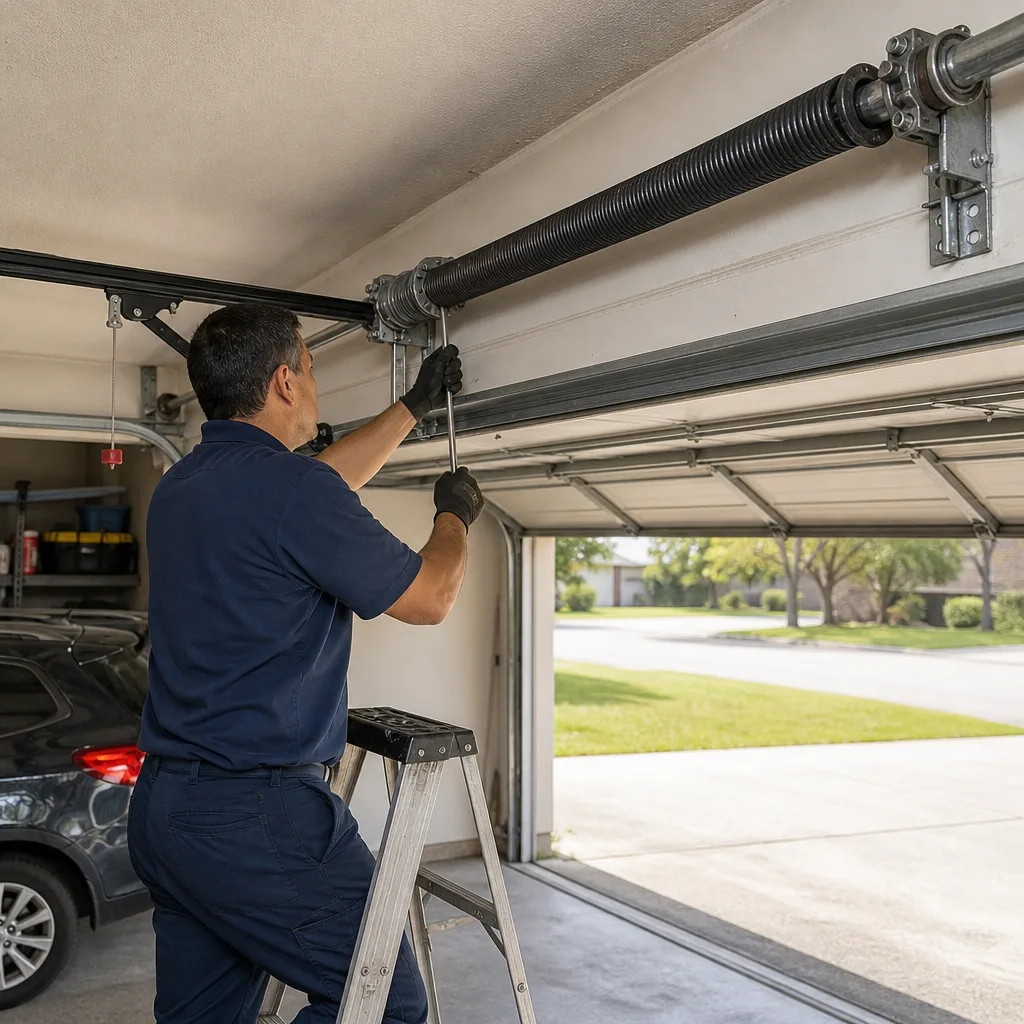
- Test the spring balance by hand. Disconnect the opener (pull the red release cord) and manually lift the door halfway. It should stay in place, not drift up or slam down. If it won’t hold position, the spring has lost tension and needs attention before peak heat. This is a diagnostic check, not a DIY repair, torsion springs are under extreme tension and should only ever be adjusted by a trained professional.
- Listen during a full open/close cycle. A smooth door is nearly silent. Grinding, squealing, or a rhythmic “thunk thunk thunk” tells you which component is failing: rollers, hinges, or the spring itself. Identify the sound in March and you’re fixing a $30 part instead of replacing a $300 spring in October.
- Inspect the bottom seal for heat warping. Houston’s high summer temperatures warp rubber seals long before they crack. Look for gaps between the seal and the concrete, or sections that have curled away from the door. A warped seal lets hot, humid air and insects into the garage all summer, and it’s also where storm water finds a way in during hurricane season.
- Lubricate all moving metal parts. Use a silicone or lithium spray on the rollers, hinges, and the spring itself. Houston’s humidity attracts dust, and dust plus humidity creates a grinding paste that accelerates wear. A two-minute lubrication in March will keep the door moving smoothly all summer.
- Check photo-eye alignment. The safety sensors at the bottom of each door track get knocked out of alignment by routine bumps, kids, bikes, and Houston’s shifting clay soil. If the sensors misalign mid-summer, the door won’t close. Test them in April by closing the door and passing your foot through the beam. The door should reverse. If it doesn’t, it’s a quick fix: clean the lens and realign until the indicator light is solid.
What a pre-summer visit catches. In our experience across Houston, the March – April window is when we find springs that have lost two or three turns of tension, rollers with flat spots from heat-softened nylon, and seals that have separated from the retainer channel. A pre-summer look is cheap insurance. Most torsion-spring replacements run $150 – $280, parts and labor included, and the alternative is a 2 a.m. failure in August when the garage won’t open and the car is inside. The Garage Door Repair in Houston call we’d rather you never have to make is the emergency one at 7 p.m. during hurricane season.
Storm-Season Readiness (June – November): Wind, Rain, and Door Bracing
Houston’s hurricane season runs June 1 through November 30, and the garage door is one of the most vulnerable points of the entire house during a high-wind event. A double-wide garage door presents 80 to 110 square feet of surface area to a hurricane’s wind load. If it fails, the pressure differential can lift the roof.
Most homeowners think storm readiness means buying plywood and sandbags. It also means checking the door itself.
How to assess your door’s wind resistance.
- Check the manufacturer’s wind rating. Doors built after 2007, when Houston’s building codes were updated after Hurricane Ike, may carry a wind-load certification. Look for a label on the inside of the door panel or check your original paperwork. If your door was installed before 2007, or if you can’t find documentation, assume it’s not rated for high-wind events.
- Inspect the track brackets and mounting hardware. The track is only as strong as the bolts holding it to the door jambs. Over time, Houston’s humidity and door vibration can loosen or rust those fasteners. Grab the vertical track and pull. It should not flex. If it moves, the brackets need tightening or replacement before a storm, not after.
- Verify your bottom seal is intact and seated. A missing or warped bottom seal is how wind-blown rain enters the garage. During Hurricane Harvey, we saw homes where garage flooding started through a two-inch gap at the bottom of the door, not through foundation cracks.
- Test the opener’s manual release. If you lose power during a storm, you need to be able to open the door by hand. Garages in flood-prone areas like Meyerland, Kingwood, and parts of Katy should always have a functioning manual release. Test it once in May. If the door is balanced, it should open easily. If it’s heavy, the spring has lost tension and the door is a hazard in a power outage.
Should you install hurricane bracing? If your door faces east or south, toward the Gulf, and your home is in an evacuation zone, bracing is worth considering. A retrofit brace, or better yet a wind-rated door, can be the difference between a garage that survives a Category 3 event and one that peels open. The Garage Door Installation in Houston route is the only way to get a true high-wind rating, and if your door predates 2007, you may want to consider it. A new wind-rated door typically runs $1,800 – $4,500 installed, depending on size and insulation.
Post-Storm Inspection: What to Check After a Tropical Weather Event
Once the storm has passed and the power is back on, Houston homeowners tend to check the roof, the windows, and the fence. They rarely check the garage door, and that’s a miss. Tropical weather events bend tracks, flood spring mounts, and lodge debris in the door’s path. A door that survived the storm can still have hidden damage that fails weeks later.
Here’s a post-storm inspection routine, in order of priority:
- Look for visible track damage before operating the door. If the track is bent, bowed, or pulled away from the wall, do not run the opener. Running a door on a bent track can shred rollers, snap cables, and turn a $150 track repair into a $600 multi-part replacement.
- Clear debris from the door’s path and from the track channel itself. Storm winds carry leaves, shingles, and small branches into places they don’t belong. Even a small piece of debris in the roller channel can bind the door.
- Check for water intrusion signs. Puddle lines on the garage floor, water stains on interior walls, or a musty smell indicate the bottom seal or side weatherstripping failed during the storm. Address the seal now, before the next event.
- Run a full open/close cycle and listen. Any new grinding, squealing, or hesitation is a red flag. A door that shudders during operation may have a slightly bent track or a damaged roller that will only get worse.
- Check the spring for rust bloom. Salt-laden coastal air from storm surge accelerates corrosion on exposed spring coils. If the spring shows fresh rust, have a professional evaluate it in the next few weeks. Surface rust is often cosmetic, but pitting is a precursor to failure.
If you find bent tracks, a broken spring, or water-damaged seals after a storm, get them addressed before the next system forms. Houston’s storm season is long, and there is rarely just one event.
The Short Houston “Winter”: Freeze Effects on Spring Tension
Houston’s version of winter lasts about six to eight weeks, usually from mid-December through early February, and it rarely stays below freezing for more than a day or two at a time. But those brief dips below 40°F, and especially below freezing, do change how your garage door operates.
What a freeze does to torsion springs. Spring steel contracts as temperatures drop. A torsion spring that is perfectly calibrated at 80°F becomes measurably stiffer at 25°F. For a homeowner, that means the door feels heavier during a freeze, not because the spring is failing, but because cold metal is less elastic. The spring has not permanently changed. Once temperatures return to Houston’s normal 60°F winter range, the door should feel normal again.
But here’s what you should check after any freeze event:
- Run a balance test after temperatures drop below 40°F. Disconnect the opener and lift the door manually. If the door is significantly heavier during the cold snap but returns to normal balance once temperatures recover, your spring is fine. If the door remains heavy after things warm up, the freeze exposed a spring that was already losing tension.
- Inspect the bottom seal for freeze cracks. Rubber seals lose flexibility in the cold. A seal that was already sun-bleached and brittle from summer heat can crack outright during a freeze. February is a good time to inspect the seal for splits that weren’t there in November.
- Check rollers and hinge lubrication. Cold weather thickens whatever lubricant is already in the parts. If the door sounds louder in winter, re-lubricate with a product rated for cold weather. In Houston, that means anything rated for temperatures down to 0°F will handle our rare freezes without issue.
Houston’s winter is the only time of year when the traditional seasonal maintenance calendar aligns with ours. It’s a short window, but it’s a useful one: the cold makes existing problems more visible. A spring that’s lost tension will feel heavier in February than it did in October. If you notice it, address it before the heat returns in March.
Humidity and Your Hardware: Rollers, Hinges, and What to Swap
Houston’s humidity does not affect every garage door component equally. Some materials shrug off moisture. Others slowly dissolve. Knowing which is which can save you hundreds of dollars over the life of the door.
Rollers: nylon versus steel. Modern garage doors use nylon rollers with steel ball bearings, or all-steel rollers. Houston’s humidity is murder on all-steel rollers: the exposed metal rusts, the rust expands inside the track, and eventually the roller locks up and grinds a flat spot. Nylon rollers with sealed ball bearings hold up much better in humid environments. If you still have steel rollers, swapping to nylon is one of the best low-cost upgrades for a Houston home. A full set of nylon rollers typically runs $80 – $150, parts and labor included.
Hinges: stamped steel versus galvanized. The hinges that connect your door panels are typically stamped steel, powder-coated to resist rust. But the powder coating wears through at the pivot points after a few years of operation. Once the bare steel is exposed, Houston humidity rusts the hinge from the inside. Galvanized hinges cost a bit more but resist corrosion significantly longer. If you live in an area with consistently higher humidity, like Sienna, Pearland, or anywhere east of the Beltway, galvanized hinges are worth specifying.
Springs: oil-tempered versus powder-coated. Torsion springs in Houston should be powder-coated. Oil-tempered springs, which are common on older doors, rust much faster in humid air. Ask the supplier or technician what kind of spring is going on your door. If it’s not powder-coated, you’ll be replacing it sooner than necessary in this climate.
What to maintain versus what to swap. Here’s the practical breakdown:
- Maintain: nylon rollers (lubricate annually, no need to replace unless bearings fail), powder-coated hinges (lubricate annually), aluminum tracks (wipe clean, no rust risk).
- Swap out proactively: all-steel rollers (replace with nylon), oil-tempered springs (replace with powder-coated when it’s time), non-galvanized hinges (replace with galvanized when they show rust).
This is where Houston-specific knowledge matters. A generic maintenance guide will tell you to “lubricate the rollers” without mentioning that your rollers may be a material that simply isn’t suited for this climate. Bramwell Garage Doors Houston has been servicing the city under the Kingswell standard since 2001, and we’ve seen exactly which components fail first in this humidity. Not which brands, which materials.
Bottom Seals and Weatherstripping: Houston’s First Line of Defense
The bottom seal on a Houston garage door works harder than any other single component on the door. It sits on concrete that reaches 120°F in the summer, freezes in rare winter snaps, floods during every heavy downpour, and gets scraped by whatever the garage floor accumulates. Houston homeowners should inspect the bottom seal every six months, and expect to replace it roughly every three years.
Signs the bottom seal needs replacing.
- Visible gaps between the seal and the concrete floor (daylight or water entry lines)
- Stiffness: a pliable seal is healthy; a rigid seal is sun-damaged and nearing failure
- Cracks or splits along the rubber, especially at the fold points where the seal doubles back on itself
- Curling away from the door: heat warps seals, and a curled seal doesn’t seal anything
- Water streaks or puddle marks inside the garage after a normal rain, not just a storm
Also check the side and top weatherstripping. The vertical weatherstripping along the door jambs and the strip at the top of the opening keep out rain, insects, and hot, humid air. Houston’s intense sun degrades the plastic and rubber compounds in these strips faster than most climates. Pinch a section between your fingers: if it crumbles or feels brittle, it’s time to replace it.
Bottom seal replacement is typically a $60 – $120 job, parts and labor included. Side and top weatherstripping runs in a similar range. It’s maintenance that pays for itself in lower cooling costs and drier garage floors, and it’s one of the few garage tasks most homeowners can do themselves safely. That said, if the retainer channel is bent or rusted, the seal will never seat properly. At that point, call a professional to replace the channel along with the seal.
If you’re wrestling with your bottom seal after a Houston rainstorm and it’s not sealing even after replacement, the door may be out of level. Clay soil in Houston shifts, the slab settles, and a door that was perfectly aligned at installation can sit a quarter inch off the floor five years later. That’s a track alignment correction, not a DIY project.
Common Mistakes to Avoid
- Following a fall/spring maintenance calendar. Most generic guides tell you to do heavy maintenance in the fall. In Houston, fall is when the damage from summer heat has already happened. Do the heavy checks in March and April, before the heat peaks.
- Ignoring a noisy door because it still opens. Noise is the earliest warning sign of failing rollers, hinges, or springs. In Houston, that noise usually gets worse in summer, not better. Address it when you first hear it.
- Spraying WD-40 on rollers and hinges. WD-40 is a solvent, not a lubricant. It strips existing lubrication and leaves the metal dry, which accelerates rust in Houston’s humidity. Use a silicone or lithium spray instead.
- Skipping the bottom seal because “it’s just a small gap.” In Houston, a small gap admits humid air, insects, and storm water. That small gap is also how snakes and rodents get in. Replace the seal when you see gaps, not when it falls off.
- Assuming a post-2007 door is automatically hurricane-rated. Not every door sold after Ike’s code updates carries a high-wind rating. Check for the label. If you can’t find it, assume the door is not rated.
- Running the opener after a storm without checking the track first. A bent track and a running opener are a bad combination. Inspect first, operate second.
- Deferring spring replacement because “it still lifts the door.” A spring that has lost tension is working harder than it was designed to, and it will fail at the worst possible time. In Houston, the worst possible time is often during a storm evacuation.
When to Call a Professional
Most of the inspections and lubrication in this guide are simple enough for a homeowner to handle. But some garage door work is genuinely dangerous, and it should never be a DIY project. Torsion springs are under hundreds of pounds of tension. If one releases during an amateur repair, the injury risk is severe. Cables, tracks, and spring mounts all fall into the same category.
Call a professional if you notice: a broken spring, stretched or frayed cables, a bent track, a door that won’t balance even after lubrication, or a door that has come off its track entirely. Any repair involving the spring, cables, or track is a trained-professional job, not a YouTube tutorial.
Bramwell Garage Doors Houston offers free estimates in Houston, call (903) 989-4180. Every visit includes a written price before any work starts, so the number on the invoice matches the number you heard on the phone. And every repair is backed by the 365-Day Done Right Promise: if the repair fails within a year, we come back and fix it at no charge, and that commitment is in writing.
Frequently Asked Questions
In Houston, a professional inspection every 12 months is enough for most doors, but the timing matters more than the frequency. Schedule it in March or early April, before summer heat peaks. A spring inspection will catch heat-related wear before it becomes a September failure. If you do the six-month homeowner checks in this guide as well, once-a-year professional service is sufficient. Call (903) 989-4180 for a free estimate on a seasonal inspection.
Garage door springs break in Houston in September because four months of daily heat cycling, from 70°F at night to 100°F+ inside an uninsulated garage during the day, creates microscopic fatigue in the spring steel. By September, springs that were already near the end of their rated cycle count fail. The timing isn’t a coincidence; it’s the cumulative effect of summer heat. Spring replacement typically runs $150 – $280 in Houston, parts and labor included, and the Garage Door Spring Repair in Houston technicians see this pattern every year.
You can absolutely lubricate your own garage door. Use a silicone or lithium spray on the rollers, hinges, and the torsion spring. Do not use WD-40, which strips lubrication and accelerates rust in Houston’s humidity. Annual self-lubrication is safe and takes about ten minutes. If you’re not comfortable reaching the spring or you’d rather have a professional look at the whole door while they’re there, a seasonal visit from a trained technician covers lubrication plus the checks you might miss.
Look for a wind-load certification label on the inside of the door panel or check your original installation paperwork. Doors installed after 2007 may carry a wind rating, but not all do. If you can’t find documentation, assume the door is not rated. If you live in an evacuation zone or your door faces the Gulf, a wind-rated door is worth considering. A new installation typically runs $1,800 – $4,500 in Houston, depending on size, insulation, and wind-load rating.
A hard freeze in Houston doesn’t permanently damage a healthy spring. Cold temperatures make the steel temporarily stiffer, so the door feels heavier during the freeze, but the spring returns to normal once temperatures recover. What the freeze does do is expose springs that were already losing tension, because the cold amplifies the symptom. If your door feels heavier even after temperatures warm back up, the spring was already failing and the freeze just made it obvious.
After a hurricane or strong storm in Houston, check the track for bends, clear debris from the roller channel, look for water intrusion signs, run a full open/close cycle and listen for new noises, and inspect the spring for fresh rust. Do not run the opener until you’ve verified the track is straight. If you find bent tracks, a broken spring, or water-damaged seals, call (903) 989-4180 before operating the door again.
The Bottom Line
Houston’s garage door care calendar runs on heat and humidity, not on spring and fall. Pre-summer checks in March and April catch spring fatigue before it becomes a September failure. Storm-season readiness in May and June protects the largest vulnerable opening in your house during hurricane season. The short Houston winter is a diagnostic tool, not a maintenance burden. And the bottom seal is working harder than any other part on the door, so inspect it every six months. Do the homeowner checks, swap out materials that fight Houston humidity, and involve a professional when the spring, cables, or track are in play. For ongoing maintenance tips, visit our more guides & resources page.
Written by Marcus Ellery, Owner at Bramwell Garage Doors Houston, serving Houston since 2001.
For a free estimate on seasonal service, spring replacement, or any garage door need across Houston, call (903) 989-4180. A live person answers 24/7, and every visit starts with a written price. The Bramwell Garage Doors Houston home team works to the Kingswell standard on every job: written price, real arrival window, clean job site, written guarantee. The 365-Day Done Right Promise means if the repair fails within a year, we come back and fix it at no charge, in writing, every time.
See the difference
 Before
 After
After Before
 After
After Before
 After
After